Showing posts with label survey. Show all posts

08 April 2012

Gold buying patterns

Picks from a paper I wrote about gold buying patterns for FDG 2012. The data comes from an online questionnaire completed from March to May 2010 by 2800+ WoW players from around the world. Unless mentioned, all results are significant with a p-value below 0.01.

  • Overall, 14% of people have ever bought gold.
  • Men are twice more likely to buy gold than women (17% vs 8%), but there is no difference between Asians and Westerners.
  • Achievement increases the likelihood to buy gold, while immersion decreases it. The effect of achievement is stronger on men.
  • 12% of people who only play with people they know IRL have bought gold. This ratio increases to 15% for people who play with both RL relatives and friends made IG, and to 21% for people who play only with friends they made IG.
  • Overall, people who have taken longer breaks from the game are more likely to buy gold.
  • But really, it's a big mess to know which variables influence gold buying: in the correlation graph below, vertices represent variables, and edges bearing positive/negative values indicate positive/negative correlations between two variables. Values closer to 1 in absolute value indicate higher correlations.
  • That's where GLM come in handy: they account for interactions between variables in regressions from multiple variables.
  • Controlling for all other variables, the odds of buying gold increase when playing on a private server, being a man, having frozen one's subscription, having made friends IG, playing for achievement, and having played the game for a long time. On the other hand, the odds
  • Controlling for all other variables, the odds of buying gold decrease when having had a college education, playing for immersion or socializing, and playing with cousins, siblings, or spouse.

01 November 2011

21st Century Game Design - Part I

21st Century Game Design, by Chris Bateman and Richard Boon, 2005.

Part I - Games exist primarily to satisfy the needs of an audience

ch1 - Zen game design

Zen Buddhism can not be learned, it can only be experienced. There is no objective perspective on anything. Hence zen game design's tenets: game design reflects needs + there's no single method to design + there exist methods to game design. These methods are:

  • first principles: what you want to do -> game world abstraction -> design -> implementation
  • clone and tweak: most common method. existing design -> tweak -> implementation
  • meta-rules: goal = provoking debate. meta-rules -> design -> implementation
  • expressing technology: in teams without actual game designers. technology -> game implementation
  • Frankenstein: art or technical materials -> design -> implementation
  • story-driven: narrative -> design -> implementation

Participants in the game project: audience, publisher, producer, programmers, artists, marketing/PR, license holder. Example: saving for causal audience is vital; for hardcore audience, it should not break gameplay; for programmers, it's a technical detail; for producer, it's looking at how other games do it.

ch2 - Designing for the market

The commercial success for a medium clears the way for artistic expression, not the way around

A game design is successful when the target audience is satisfied. This justifies the need for an audience model. Existing models: simple distinction hardcore/casual, distinction by genre (but genres are too vague), EA's model, and ihobo's model.

Simple hardcore/casual distinction
hardcore casual
plays lots of games plays few games
game literate game illiterate
plays for the challenge plays to relax, kill time, and just for fun
segment can be polarized: many can buy the same title hard to polarize, diverse and disparate

EA's model:

EA's model take-away: do not ignore hardcores because they are the ones pushing a game to broader segments. Corollary: no TV ads are needed if the game is not made for casuals.

iHobo's model:

Evangelist clusters = gaming press, mainstream press, and the 3 million of hardcores in the world. Target clusters = Testosterone (9M players worldwide), lifestyle (30M), and family (90M) gamers.

Design tools for market penetration (aka demographic game design):

  • Looking for good gameplay (ie the game being performance-oriented, with stats, clear goals and victory conditions) vs good toyplay (unorganized). Hardcores are driven by gameplay, but lifestyle and family gamers are driven by both.
  • Controls should remain accessible for casuals.
  • The minimum play session length is usually expressed in terms of the duration of a level or the time between two save points. For casuals, it should be below 15 minutes, but hardcores do not mind core activities of a game taking at least an hour or two. Ex: a typical DotA match takes 45 to 60 minutes, whereas a (small size) Mine Sweeper can take less than a minute. Nintendo games are also famous for allowing the player to quit at any time and provide core activities of at most a few minutes.
  • The average play session length is also lower for casuals: they may complete one level at a time, whereas hardcores can aim at 10 levels per play session.
  • Play window: total time spent playing the game. The longer the play window, the longer hardcores will spend evangelizing the game. Therefore, despite most of the players not completing the game, content is crucial! The play window can also be extended by introducing hidden features, higher difficulty levels, variety in characters to play with (to increase replayability), and online PVP (although that only works for Testosterone and hardcore gamers).

Phases of penetration: taking the example of The Sims.

  1. Hardcore penetration: the game needs challenge, progress, and depth.
  2. Hardcore evangelism: the game needs to appeal to the Lifestyle gamer, easy to reach fun, strong marketing, and a strong license.
  3. Casual penetration: the game needs fun, toys, short minimum play session.
  4. Casual evangelism: the game needs to get the attention of the mainstream press.

ch3 - Myers-Briggs typology of gamers

Assumption: nature of games people enjoy and frequency of play vary with player personality and reaction to situations. The Myers-Briggs model was developed in the 1940s and indicates how an individual would prefer to react to situations in general. See the Myers-Briggs type frequencies in the US. Four pairs of traits:

Type Opposite type Game design
Introversion (50% of pop)
think then act, needs private time, 1-to-1 communication and relationships
Extroversion (50% of pop)
act then think, likes people, deprived when alone
Most games are played by introverts. Extraverts can take long breaks from the game, so provide a todo list for them when they come back to play, otherwise they'll forget what they had to do in their previous play session. Extraverts like DDR because of its performance aspect.
Sensing (70% of pop)
live in the present, apply common sense, based on prior experience, likes clear and concrete info
iNtuition (30% of pop)
live in near future, new and imaginative approaches, based on theory, comfortable with fuzzy information, seek for patterns)
Learning and problem solving are frequent gameplay elements in many genres. Learning: in tutorials, S will accept linear series of lessons, but N would rather guess by themselves. Problem solving: S will use trial and error, while N will like to use their lateral thinking skills. Therefore, make lateral thinking puzzles (at most) secondary objectives, or allow the player to progress without having completed all of them. Ex: Super Mario 64 only requires 30 stars to unlock new levels. S want simple and usual mechanics, while N won't mind having to guess the rules and a steep learning curve.
Thinking (30% of women, 60% of men)
decide from facts and logic, objective, focus on task, think that conflicts are sometimes unavoidable
Feeling (70% of women, 40% of men)
decide from emotion, subjective, focus on consequences to people, wish to avoid conflicts
Clear goals for T. Personal encouragement for F, but T may feel patronized. Solution: useful AND aesthetic/fun items are rewards that will satisfy both T and F. Gathering collectibles give goals to T, but should not be a grind. F are motivated and rewarded when they see their actions have impact on the world or other characters. T enjoy receiving critical feedback (a game over with tips), but F will take it personally. Ex: Zelda gives clear goals (good for T), falling or getting hit results in losing half a heart (and not instant death) and Link has an impact on the game world (good for F).
Judging (55% of pop)
plan then move, single task at a time, ahead of deadlines, targets and routines to manage life
Perceiving (45% of pop)
plan as you go, multitask, work better before deadline, avoid routine and commitment
J want to beat the game (get all the secret bonuses) and complete objectives. P want to improve their abilities, and enjoy the process. For P, goals completed = feedback that they're on track. Non-linear structure is good for P because if they don't like a level, they can try another and keep progressing. J needs to know what to do to progress. Ex: in Tony Hawk or GTA, players need to collect points (good for J) but they can collect them the way they want (various kinds of skate figures or driving/killing missions or sandbox play, good for P).

TJ vs FP: TJ want challenges to overcome (what most current games provide), FP want easy fun (cf Sims or casual games).

Study hypothesis: hardcore player is a 14-28 year old tech savvy male who plays up to 8 games per month. Supposedly, he plays on his own (hence I), is methodological, goal-oriented enjoys conflicts (T), plays games until completion and looks for perfect score/overachiever (J). Previous quantitative work from the Bartle test by Andreasen showed the average hardcore MMO player is IST. Therefore, let's suppose hardcores are IT. Overall, 15% of women and 35% of men are of type IT.

ch4 - DGD1

DGD1 is intended as a tool to aid in market-oriented game design.

Methods: between 2002 and 2004, ask 408 participants (incl 122 women) to answer a 32-question Myers-Briggs personality test, as well as questions on purchasing and playing habits, and do you consider yourself hardcore, casual, or no idea?. Only look at people who play at least one game per year. Survey advertised on hardcore and casual websites/game portals + university students.

Results: clustering gave a sketchy and incomplete result, and FE and SI dimensions did not help to cluster, but 4 clusters appeared anyway: conqueror (TJ), manager (TP), Wanderer (FP), and participant (FJ). Hypothesis rejected: hardcores are found in E and S (and not only I and T). Still, I and N are higher for hardcores and MMO players than casuals. For each of the four types, twice more respondents reported they were casuals than hardcores.

The DGD1 demographic model
Type Hardcores Desc Casuals Desc Progress Story Social
Conqueror ITJ. Want meaningful challenges, strategies and puzzles, want to complete the game. Want lots of content, try to beat themselves. The game is too easy if they don't die at least a few times. Anger, frustration, boredom, and fiero. ISTJ. FPS and racing games, they play to compete and win. Rely on genre conventions and do not like deviations from the genre. Fiero (although it's oblivious to them) and schadenfreude in PVP, or in GTA for rampages Rapid advancement: stats in RPG, better gear in FPS Focus on plot twists/events, not on characters Online: vocal hardcores from forums and blogs. They also like to win discussions
Manager ITP. Strategy and tactics. Winning is less important than mastering the game systems: process-oriented, not goal oriented. Conquerors consider them rivals and targets. Patient. Look for challenging but not impossible. Don't look for hidden features but rather refine their current knowledge. Fiero. Civ series. ISTP. Want familiar settings and realism. Like construction and management games like SimCity. Hate being stuck even if they suck. Hate interruptions and like smooth difficulty curves. Steady. Give up if no reliable strategy is found quickly. Plot, not characters. None?
Wanderer INFP. Easy fun and toyplay, not challenges. Variety keeps the fun going. Complete levels in aesthetically pleasing ways. Cf Puzzle Bobble/Bust-a-Move: simple controls, bright colors, and actions with direct and satisfying changes to the environment. See also Mario Party and Super Monkey Ball. Need to be able to give up the current task for another different task. May turn to Conqueror or Manager relatives for help. Emotions: finesse, aesthetics, wonder, awe and mystery, but no fiero. ENFP. Want to accomplish something in the game world without the need for challenges. Games = way to relax. Feeling of progression or else boredom. Lack of market vectors to reach them [although nowadays there's Facebook] New toys, colorful and imaginative environments Emotions. Empathy to characters or investment in world/immersion. Talk about what they like but avoid arguments
Participant FJ. Games as social entertainment. Cf DDR, The Sims. Little survey data about this group. Narrative of group of players Characters and emotions, but in control of them, not just spectator. Multiplayer, but must face other players in person, not just online (no MMO)

ch5 - Player abilities

Flow = subjects believe they can complete their activity. Subjects have clear goals and direct and clear feedback. Effortless involvement. Goals should be short-term for participant and conqueror, but long-term for Wanderer and manager because they like to figure out the short-term goals themselves.

Caillois' table of the four categories of play helps understand how flow is related to toyplay. In the table, there really is a continuum between Paidia and Ludus.

The relation between the four play styles of DGD1 and Caillois' categories of games
Conqueror
Agon
Manager
Agon (Alea tolerated)
Participant
Mimicry
Wanderer
Mimicry (Alea tolerated)
Caillois' table of the four categories of play
- Agon
(competition)
Alea
(chance)
Mimicry
(simulation)
Ilinx
(vertigo)
Paidia
(spontaneous play)
Spontaneous races Counting out rhymes, coin flipping Masks and disguisement Children whirling, swinging
Ludus
(structured play)
Sports Betting, lotteries Theatre Skiing, mountain climbing

People with high Myers-Briggs Feeling scores prefer avoiding conflicts, therefore they don't like Agon. They're also more likely to like Mimicry since they focus on people. For example, Wanderers appreciate finesse, which is a component of Mimicry. Ilinx resembles immersion, it appeals to everyone.

Temperament theory gives patterns of behaviors, while Myers-Briggs gives patterns of perception or judgement.

Temperament theory
Temperament Core needs Myers-Briggs traits Skills % of pop
Rational Knowledge, competence NT Strategic: Think and plan ahead, identify the means to achieve a goal, coordinate actions strategically 10%
Idealist Unique identity, search for meaning and significance NF Diplomatic: Resolve conflicts while recognizing individuality, empathy, find similarities through abstraction 15%
Artisan Freedom to act and ability to impact SP Tactical: Read the current content and manage the situation, work out the next step and take action, improvise to overcome problems 25%
Guardian Belonging and sense of responsibility/duty SJ Logistical: Organizing and meeting needs, optimizing and standardizing, protect and ensure safety 50%

Temperament, Myers-Briggs and DGD1
Type Myers-Briggs
traits
Hardcore
temperament
trait
Casual
temperament
trait
Flow provenance Examples
Conqueror TJ strategic logistical Capacity to see in advance how to address problems (strategic) and iterate/repeat to improve/optimize the solution (logistical). Willingness to fail and repeat Production of units in RTS, monsters or bosses with patterns (cf Doom monsters)
Manager TP strategic tactical Planning ahead (strategic) and reacting to rapidly changing situations (tactical). Hardcores like to get lost in their thoughts, ideally without time limitations. Casuals have flow in the action, and need short-term goals. RTS have both spontaneous maneuvers and long-term strategies. Civ, Chess or puzzles for hardcores.
Wanderer FP diplomatic tactical Immersion, explicit short-term goals (tactical). Completion of goals is not a big thing, it happens almost as a side-effect of exploration. Give them time to explore. Platformers (goal is obvious and challenges relatively easy)
Participant FJ diplomatic logistical Feeling of belonging, toyplay, optimize relationships (logistical) with other characters or players, immerse themselves in social situation The Sims, Animal Crossing

Casual audience is best approached with familiar settings and content, and with gameplay that revolves around optimization or thinking on your feet (tactical). Hardcores prefer original games that give them a sense of identity (diplomatic), and problems to solve (strategic), e.g. Final Fantasy focuses on story and strategic battles.

05 May 2011

[Literature] Retention in WoW

Thomas Debeauvais et al. 2011. If you build it, they might stay: Retention systems in World of Warcraft. In FDG2011.

I looked at what keeps people playing WoW and which mechanisms retain most effectively which kind of players. Here are my picks from the paper I wrote and sent to FDG2011.

Around 2800 WoW players from Europe, North-America and Asia completed an online questionnaire. Player commitment (and therefore retention) was measured by three metrics: weekly play time, ratio of respondents who have ever stopped playing, and number of years spent playing WoW. All the results mentioned in this article are significant with a p-value below 0.01.

  • 96% of respondents have been playing WoW for more than a year, 70% for more than three years.
  • 23% of respondents have stopped playing for more than 6 months and have never canceled their subscription - they keep paying even if they do not play!
  • On average, people play 23h/week. Asians play more than Westerners. No noticeable difference between men and women.
  • Achievement and social actions are motivations that increase the weekly play time. Immersion does not influence the weekly play time.
  • Asians are more immersion-oriented than Westerners.
  • A higher guild rank (officer or GM > basic member > non-guilded) increases retention.
  • Women play with people from real-life more than men.
  • People who play with their partner play less than single players, but more than players not playing with their partner. They also stop playing less often.
  • 13% of players have found a real-life boyfriend/girlfriend/spouse in WoW.
  • There are more players over 45 than players who play more than 40 hours per week (another sample may contain a different ratio, though)

22 April 2010

[Literature] Productivity and play in organizations

In Productivity and play in organizations by Hansen et al. (2009) are described the reactions of executives when asked about using virtual worlds (VW) for their business. Hansen et al. analyzed 25 business executive written reports after they had spent some time evaluating Second Life as a valuable platform for companies. 7 sensible topics have been extracted from the reports by the researchers.

In the context of virtual worlds, productivity can have very broad and different meanings depending on who is producing, who is getting benefits from the production, what is created, and so on. Hence the researchers narrow and explain their definition of productivity: they try to answer the question In what ways can virtual worlds enhance the operation of everyday organizations?. In other terms, they look for productivity as measured through … revenue generation and cost control. Asking executives their opinion was important for this study for two reasons. First, executives are the ones who are effectively in charge of revenue generation and cost control. Second, they are instrumental in the adoption and appropriation of such a technology by the company because they are the ones who decide of using a VW or not.

The methodology followed by Hansen et al. deals with analyzing the reflection papers produced by MBA students and extract the key information from them. The first phase of their analysis was a grounded-theory-oriented comparison of the reports to identify patterns (open-coding). After having had a sense of the overall content, they started to gather the arguments in favor and against the use of VW for business (selective-coding).

Seven tensions, or points of disagreements between respondents, were identified. I replaced some of the cells of table 2 given in the article to illustrate the arguments in favor and against the use of Second Life for business.

Tension In favor Against
Popularity 40,000 residents at any given time Residents not in the business-oriented locations, Web2.0 social websites have 100M+ users
First-mover Get used to SL now for long-term benefits The SL phenomenon is slowing down, we wait for more robust VW platforms
Demographic Young and tech savvy Geekiness, social awkwardness
Anonymity Honest and uninhibited information Trust issues & misinformation
Sociality VW brings more social presence than other electronic media Limited social cues
Experience Immersion & 3D prototyping Lack of authenticity
Social Benefit Freedom (virtual tourism, expression) and therapy Dehumanizing

These tensions have also been cross-tabulated with the business application they affected: marketing and brand awareness, training and distance learning, meetings and collaboration, product innovation and testing, recruitment and interviewing, and virtual tours. Marketing and organizational training were the two domains where VW could bring the most valuable help to businesses. However, respondents recognized that marketing in the context of VW is very recent and requires particular skills the company does not always have. Community marketing, a new skill of the community manager?

In the last decade, the business press has been split in two sides: those who say VW are the future, and the careful, more conservative ones. Based on a CMC approach, Hansen et al. remark that lack of control and depersonalization are the two main concerns with the use of VW for businesses. In the light of previous CMC works, the reluctance to use VW may decrease as familiarity with the medium increases. However, VW provide synchronicity and 3D graphics, affordances unseen in older electronic media such as email or forums. Research has a role to play in determining if previous CMC results still apply to VW.

10 October 2009

RO Official F2P servers

This is following my last post.

F2P servers strategy

... but considering that :

  • a lot of RO players are Asian (I could not find any proof of that but I truly believe it regarding the reaction of surprise all Western people have when they hear that RO has more than 10M subscribers, considering also that according to wikipedia, though unknown to many Western players, the game took Asia by storm)
  • F2P Asian MMO Games (like Maple Story for instance) could attract RO subscribers according to Aaron Delwiche

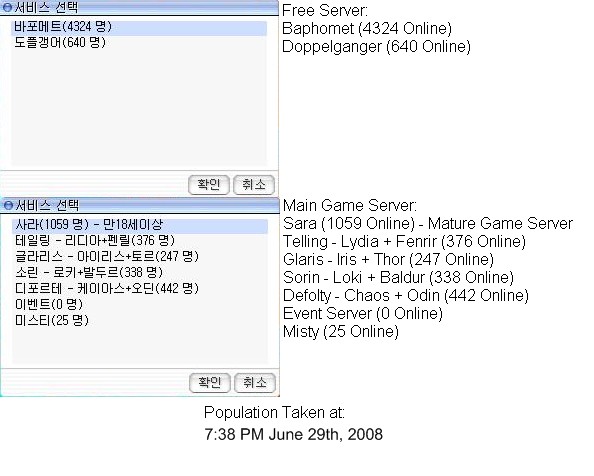
Gravity changed its (world) strategy in launching F2P servers such as Valkyrie for iRO or Baphomet for kRO. Also, the French server fRO which used to be P2P became F2P in December 2008. The Russian server ruRO is also F2P (I do not know if it was P2P before).

Valkyrie

This server is an iRO server and opened in September 2008. The game on Valkyrie is harder (XP is harder, Teleporting is more expensive, Kafra Mall Items are more expensive, etc.) but it is a free server, so players go to play on it. Actually, there are more players on Valkyrie than on the other P2P iRO servers (see ropd.info).

Considering the 4 figures on the left concerning players on iRO servers Loki, Chaos, Iris and Valkyrie, some comparisons have to be made :

  • Different server ages : Valkyrie is much younger than Loki/Chaos/Iris, so I think there is a lower ratio of high-level people on Valkyrie than on P2P servers.
  • Different guild involvement : Usually, people go into a guild when they have a bit of strength to bring in, that means when accessing job 2, at approximately level 60. So if we forget avatars who are under level 60, the P2P servers have more than half of their high-level avatars in guilds while in Valkyrie it is approximately 9.000 high-level avatars in guilds for 26.000 not.

From these facts, I do not think that it can be stated that the cost of the game experience influences the type of gamers. An easy conclusion could be : Iris/Chaos/Loki are more hardcore/experimented/PGM servers while Valkyrie is more casual/fun/low-level. But I doubt that it can be easily proven, and some very skilled players (like Doddler for instance) do play on Valkyrie.

Baphomet and Doppelganger

Since I can not read Korean, it is hard for me to gather sources concerning the kRO F2P servers, so I will not detail this part much. kRO Baphomet was launched in May 2008 and is also harder than other kRO servers. As I wrote before, RO F2P servers gather sometimes more players than P2P servers (see Server selection screen nearby), and it is the case for Baphomet. More about Baphomet on Doddler's website. The motivation for opening a free server at this time was the declining number of users. Doppelganger opened in June 2008. It did not bring as many users as Baphomet so the 2 were merged in April 2009.
Anyway, the strategy change consisting in opening F2P servers has been definitely fruitful because Gravity says in April 2009 that the subscription revenues increase in Korea was primarily attributed to increased revenues from launching free-to-play servers.

fRO

To my mind, fRO tries to push the player to buy a Premium Account, or the upgraded version of it : the Infinity Account. I do not know about ruRO (which is also F2P), but it might be the same as fRO (ruRO has at least Premium Accounts).
A fRO Premium account is a monthly 7€ subscription, while an Infinity account is 199€, providing a permanent VIP status and some bonus items.
The iShop is the same thing as the iRO Kafra Shop. It is through this website that users can buy virtual items.

Karat VS Euros : Screenshot of FRO website

I think that tokens of micropayment are a psychologic easier way for the user to buy virtual items with real money. The reason might be because people can hardly admit they are buying game items with real money, they need an item to make the transition : website tokens! In fRO, these tokens are named Karat. Actually, Carat is the name of a clown monster in the game, so maybe the Karat currency comes from its name. Currently, 100 Karats are approximately 1€.

Giant Flywing Box:Screenshot of FRO website

In my previous post, I took the example of the Giant Flywing item that can be bought on the iRO website with Kafra Points. On fRO, a user buys a Giant Flywing for 10c (10 Giant Flywings for 100 Karats). Compared to the iRO 0.75c Giant Flywings, there is quite much difference.
I think the only reason explaining this difference is the will of Gravity Europe, administrator of fRO, to produce an amount of money big enough to be compared to what other Gravity group branches produce (ruRO, jRO or even iRO). But it is quite difficult for Gravity Europe, because the French player community is much smaller than iRO's, and therefore is likely to bring less profit. So the same products are more expensive on fRO than on iRO in order to «cope» with the size of the community.

fRO website : most sold items in the iShop fRO Price Watch

Bubble-gum, a kind of item which increases experience gained in killing monsters (see Doddler's BubbleGum tests), is the most sold item IG, but is also the best selling item bought with real currency (€). Lucky Clip is a kind of item that increases the drop rate of monsters and is also among the best selling items. All the other items are «everyday life» items : Oridecon and Elunium are used to refine and repair player weapons and equipements, Yggdrasil Leaves are used to resurrect people and Blue Gemstones to teleport people from a place of the world to another.
What is interesting with Lucky Clips and Bubble Gums is that these items are not dropped by any monster nor sold by any NPC, hence all these items are available to players because they have been bought with euros. That means that even if Gravity Europe does not sell (itself) zeny for euros, roughly 400.000z = 100Karat = 1€. On igvault.com it is possible to get 1Mz for nearly 6€. That makes a huge difference with iRO where it is possible to get 20Mz for 6€/8$. But what is more interesting is that Gravity Europe has a twice better change rate than illegal websites. Because some people want to absolutely soften their game experience in buying items like Bubble Gums or Lucky Clip to get more XP or drops, this could be an explanation why they would rather buy these items through ragnarokonline.fr instead of another ways.

Business Model improvement

Stat Points Window in RO

RO's leveling is definitely hard. Much harder than many well-known current MMORPGs. But with the opening of F2P servers, I do think that more casual players are willing to play, and even pay a few $/€ to appreciate more their time. Another particularity of RO is the WoE system ; a WoE is a battle between rival guilds in a castle in order to possess it and get rare items its Treasure Boxes contain. But sometimes it is difficult to build a character with PvP stats because these stats do not match PvE stats at all.
For instance, when playing a Priest (typical support class) in WoE sessions, a lot of Vitality (VIT) is needed so that your avatar does not get killed easily. On the other hand, not much Intelligence (INT) is necessary because not need many SP (= mana) are needed. But the easiest way to have your character leveling up as an Acolyte (the class the player has to be before becoming a Priest) relies on much INT to inflict more damages on Undead monsters.
Unlike most of all private servers, in official servers there are no NPC who can reset the player's stats. Hence an iRO survey in July 2006 reported that 68% of the 4266 participants of the survey say yes to a value-added service that provided a skill or stat reset and 28% said no. In another survey occuring in January 2008, 56% of the 7229 participants said they would pay for a Service or Item that provided a Full Stat Reset and 14% said no.

The only currently available service on iRO consists in buying (directly, without Kafra Points!) 20 Stat Points for $10. A level 90+ avatar has more than 800 status points. To move from a character build to another, not all the stat points need to be reset, but to my mind, it takes much more than 300 points. To my mind, this definitely can be improved ...

Reset Stat:Screenshot of FRO website

fRO has nearly the same system as iRO. This thread shows that it is 40€ for a 100 stat-point reset, and it is free if you have paid a premium account (199€). However, this reset is performed only ONCE on your character. The price can be compared to the iRO price of the nearly same service (however, the iRO stat reset can be repeated many times). How this stat reset is performed on fRO is explained on fRO forums.
I do not know the amount of «Infinity» accounts, I do not know the total amount of people using this service, and I do not know how many people have been using the stat reset service on iRO, but I bet that the F2P players use it more than the P2P players. Recently, a RO player told me that he liked that people are «equal» when they have all paid for the same service (P2P), but he definitely finds «unbalancing» the fact that some people could buy virtual items with real money (F2P). I think that is a reason why he's playing on private servers ...

27 September 2009

RO Official Servers and money

First, if you do not know what RO is, you can read this post.

kRO Sakray is the most up-to-date RO server worldwide, maybe because Gravity is a Korean corporation (and because Sakray is the usual test server). For instance, one of the latest major updates of the game is called Renewal. This update occured in July 2008 on kRO Sakray and in June 2009 on all kRO servers but has not yet been implemented on iRO servers (no update has "Renewal" in its title, or on the official server features kRO is the most up-to-date server). I would have liked to write about kRO because :

  • kRO is the most up-to-date set of servers (containing kRO Sakray, the most up-to-date RO test server worldwide)
  • kRO contains Asian players, and as I wrote before, RO is mostly played by Asian people
  • Asia MMO Gaming is not really known from Western countries. Also the by-products in Asia may be more widespread than in Europe and America, the game habits might be really different, etc.

But I can not read/understand Korean, so what follows are considerations based on iRO, the RO international server that I find most representative as a non-Asian (and understandable) server. iRO opened in June 2003 and is only a year younger than kRO, so there should not be any differences because of the age of the servers.

Concerning the administration of the servers, kRO is administrated by Gravity Corp. and iRO by Gravity Interactive (cf the server list). I do not know the relationship between these 2 firms, but each time in this post I may write the name «Gravity», it will stand for the iRO administration.

Talking about money, the RO IG currency is called zeny (z). The only origins I could find for this name are noble in Russian and a slavic word for woman (looking for zeny on google image leads to funny results ...).

Value-Added Service and Kafra Shop

As I already wrote, subscribtions are roughly $10 per month. But giving players the possibility to buy IG items or services related to their avatars with real money could bring some more money to Gravity.

First, users can use Gravity's Value Added Service for character renaming, moving (to another server), gender changing and status points reallocation. I think this service may exist since the creation of the servers because it consists only in database management.

Second, in December 2004, a survey on iRO website reported that 55% of the 1001 participants would ever pay real-world money for in-game currency or items, while 45% said they would not. Apparently real currencies against z has not been set up by Gravity yet (and I do not think it will ever be set up), but some websites suggest 6€/$8 for 20Mz.

Anyway, in June 2007 the iRO Kafra Shop opened (maybe this type of online shop already existed for a long time on kRO). Kafras are NPC located in any town or at the entrance of any dungeon to provide VERY USEFUL services such as :

  • Saving the player's position so that when your avatar dies in a dungeon, he/she returns to the dungeon entrance
  • Opening the player's storage so that an avatar can store drops and equipements
  • Teleporting the avatar from a place to another

So the name for this on-line item mall was really well-found to focus the player's mind on usefulness. The content of the item mall consists of any kind of equipements or consumable items. And indeed some of these items are really useful. For instance, the Giant Flywing is the only item in the game that gives a group leader the possibility to teleport his group where he is. The user can buy Kafra Points with USD, on a $75 for 10k points basis.

Micropayments are sometimes used for items contained in boxes (500 Giant Flywing in a 500 Kafra Points box, which means 0.75c/Flywing). As explained on wikipedia the use of a custom token like the Kafra Point is very common in MMORPG.

When the Kafra Shop was introduced, all RO servers were P2P. It is only with the introduction of F2P servers in RO that things changed a little bit.

02 September 2009

[Literature] Surveys in Virtual Worlds

Quick introduction ...

Currently, there are very many researchers in sociology focusing on Virtual World populations. Actually, there is also some psychology, economy, law and even politics research led in MMOs. Various analysis of the MMO worlds can be done : Researchers need data. To collect data from a huge amount of players, they need fieldwork tools. And the best tool for collecting people's thoughts about a very precise topic is the survey.
Basically, surveys can be conducted in the street. That is sometimes expensive and long, and brings few results. Maybe that's why street pollsters are voluntary. Thanks to Graham Bell in 1876, larger scale surveys were made possible. The rain does not impact anymore on the amount of people surveyed in the day. But pollsters still have to survey people themselves. In 1990 started an era of online surveys thanks to HTML pages. Now, pollsters only have to think about their survey, put it online and wait for their <form> to be filled/submitted by millions of people.
What about MMO player surveying? Players have to logout from the game, connect to a website on which they could take the survey. They are no more in a "player" stance : no more blade, gun, fun or handsomeness. They are simply answering a survey addressed to any WWW user, that is to say everyone (actually, not everyone ...). The ideal is an IG survey.

VDCI : the State of the Art

Chronology

In April 2008 Mark Bell, Edward Castronova and Gert Wagner published a paper concerning VASI and VDCI. Topher Zwiers, a SL educator describes a VDCI presentation from Mark Bell in a post on his blog. Castronova published on Terra Nova a very short description of the tool.
But in June 2009 (actually the survey ran for 30 days in early 2009 (02/03 to 03/05).), these same people published another paper discussing how they led a survey in SL thanks to the VDCI.

VASI and VDCI

SL kiosk Research avatar in SL If you already know about VASI and VDCI, then you can skip this part (or tell me if you see points where I could be wrong or inaccurate).
Researchers looked for a tool that preserves immersion because players have feelings and perceptions that are particular to that environment. The method they propose to solve this immersion break is called VASI, and its implementation VDCI. They used a mailing list, a classified ad system where respondents select themselves and then are teleported somewhere, and a random location protocol where their research avatar was teleported if it was possible. When it was possible, a sort of NPC kiosk appeared. No participation rate can be estimated because this NPC waited for people to talk to it.
The VDCI is a HUD (official HUD description), that is to say a control panel allowing the user to perform actions he is the only one able to see. Particularly filling a form to answer a survey. The player gets this HUD by an NPC, wears it and then can answer the questions. When he has finished, the research avatar gives the player some virtual money.

Implementation

If you already know technically about VASI and VDCI, then you can skip this part (or tell me if you see points where I could be wrong or inaccurate).
The VDCI uses LSL [...] which formatted HTTP calls that use PHP to write the respondent's answers to a MySQL database. Since Second Life is Open Source, and their wiki is quite well documented, it was not very hard to understand : see LSL, HTTPRequest in LSL and the Server Architecture (see RPC server). I think the RPC server must handle a proxy somewhere. It could be worth spending time in SL sources some day ...
Good remarkable thing, when the database did not record whether this was a person responding due to a classified ad, an email or encounter with a random kiosk, it was refered to as <no record>. I presume in the PHP scripts an argument was given to tell the provenance of the answer, and if this argument was missing or incorrect, an error was detected. Anticipating errors and making them appear in the final figure not only show the impact that could have had these errors in the final results, but also show the reliability of the use of the VDCI system in SL. I think that the percentage of <no record> may vary depending on the server(s) bandwidth and processing capacities.

Limits

  • identity in SL is fluid, so ensuring respondent identity is difficult. Actually, this is the same for any MMOG : players exchange passwords when they play in teams, guilds, with friends, etc. Also, VDCI captures the avatars name [...] to ensure that the same avatar does not take the survey multiple times. As they write, this does not prohibit a user with multiple avatars to take the survey multiple times. There might be a very easy-to-say solution for this : store the fact that an account took the survey in an account variable. This solution means either UGC API (or language) can set client-side account variables or a server owner (Linden Labs for SL) has scripted the item for the survey (thus the account variable is stored server-side).
  • Researchers were only able top place kiosks at 10% of the randomly chosen places, concentrated on the eatsern side [...] much more populated than the western side, so this is not a bias. I honestly dont know if this makes a bias. IRL, voluntary pollsters stand at very populated locations. In any MMOG, there are strategical spots where many people meet : capital city, current expansion zone where every high level is, PVP zones, etc. but people can also meet in a small unfrequented street in any town of the world or during a quest in a very particular place. These "common" zones hosting 3 players a day are part of the world and should not be forgotten.
    Anyway, because there were 1543 respondents based on classified ad and 75 respondents based on the quasi-random protocol for 2094 valid responses, and because for the overall sample the quasi response rate is 2094/1100000 = 0.2%, I consider many active people selected themselves to participate in this survey. These active players are the usual 10% of the population producing 90% of the server content/life. To my mind, passive players have not at all been surveyed.
  • This then paid the avatar 250 linden dollars. : a survey should be led, consisting of only one question : how much do you want to receive for this survey? And the answer can range from 0 to NaN. The fact that 90% of the classified ad respondents are willing to get re-contacted does not definitely mean that those people want to be paid for doing it again. I do agree on the fact that quasi-random sample and [...] classified ad sample are the samebut in the way the quasi-random survey was led : only active people were surveyed. So concluding that classified-ad sampling obtains a representative sample of the SL population is not exactly true. Quasi-random is simply more expensive, but the same sort of people are surveyed.
  • While conducting a natural experiment about the fieldwork strategy in SL, they found an increeased number of respondents after the new placement of the class ad (in a day : more than 100 compared to the usual 30). Many people may answer the survey because it is something new : a special research avatar, a kiosk, a new ad, a mail. After some days, people are used to the kiosk or the ad, it has become part of the everyday scenery of the place. And this happens faster if the NPC/element is passive : a walking, yelling and bursting NPC with fireworks might take a bit longer to be forgotten/ignored.

What else? What now?

In other MMOGs

LUA Symbol SL, as a MMOSG, has much to do with UGC : items, places ... But for typical MMORPGs like WoW, UGC has not the same place. SL VDCI needs the player to wear a HUD which is definitely something available IG thanks to UGC. The only way to implement such HUD from a UGC point of view could be WoW add-ons. I honestly doubt that current WoW LUA API permit transmitting data out from the game. I have not seen such things on wowprogramming or on wowwiki. Other recent MMORPGs dont seem to put forward add-ons, and I think WoW was the first MMO to implement such a programming tool.

MMO firms

Exctracts from the previously quoted article from Mark Bell, Edward Castronova and Gert Wagner :
  • About the register of SL users (inhabitants) which can be used for drawing a random sample : Linden Lab does not provide this kind of information for commercial or for research purpose
  • According to Linden Lab, from 02/03/09 to 03/05/09 about 1.1 million avatars were active in SL.
If firms were to participate in such surveys or share the use of such tools, it would be easier and safer for IG pollsters to implement their survey. Also, much could be done to ensure the fact that a real person (and not avatar) can answer the survey once and only once.
I contacted Mark W Bell to know if they asked Linden Labs about their survey, what support they could have asked, etc.

Quote of the day

Found on a French forum : je cherche un add-on qui permet d'xp tout en étant AFK pour faire plus de RP (translation : I'm looking for an add-on that could make me xp while being AFK so that I can RP more)